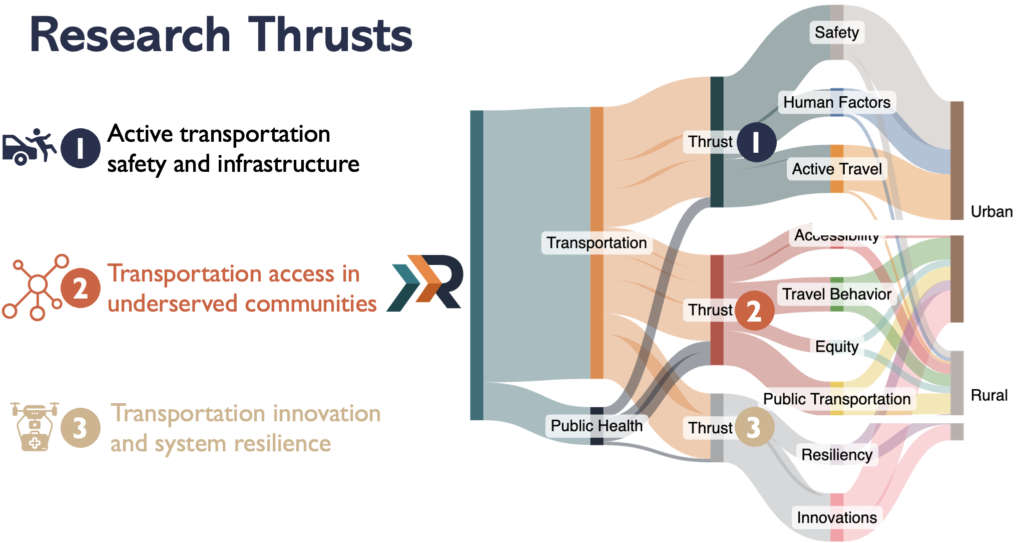
At RUTA-HC, we employ diverse quantitative and qualitative methodologies to examine transportation’s impact on public health, aiming to shape public policy and planning initiatives that pave the way for a healthier future. Recognizing transportation’s fundamental role in economic and social factors influencing community health, our mission is to drive positive change by engineering safer, more resilient, and equitable transportation systems that foster belonging and improve overall well-being.
Regarding research methods, we performed a plethora of statistical (non-spatial and spatial econometric modeling in STATA, R, GeoDa, and ArcGIS Pro), quantitative, and feasibility analyses, and have created decision-making tools to address diverse transportation-related challenges. We also have expertise in conducting qualitative analyses, surveys, mix-method analyses, and utilizing behavioral science methodologies to study complex transportation issues.
Currently Funded Projects
Sponsors
Autonomous Cargo Carriers for Enhanced Logistics in Rural & Tribal Areas
(Role: Co-PI)
ACCEL-RT explores how autonomous cargo delivery can strengthen freight access for rural and tribal communities. UNM’s work centers on a roadmap for automation-enabled multimodal logistics networks along the I-40/I-35 corridor, examining needs, opportunities, and implementation pathways to guide agencies and communities toward safe, practical deployment of autonomous freight systems.
Microtransit in Rural Areas: The What, How, and Where
(Role: PI)
Microtransit offers app-based, on-demand public transportation suited to low-density areas where fixed-route service is impractical. This research examined what makes rural microtransit feasible, how to plan and implement it, and where it fits best, drawing on interviews with 12 rural providers and a Rural Microtransit Propensity Index for New Mexico.
Evaluating Vulnerable Road User Stress During Motor Vehicle Interactions in Urban Traffic Environments (Role: PI)
This project examines how motor vehicle interactions and urban infrastructure affect cyclists’ physiological stress. Using semi-naturalistic data, including heart rate, heart rate variability, eye-tracking, and subjective responses, mixed-effects models will identify key stressors and translate the findings into guidance for safer street design.
Exploring the Influence of Tinted Windows and Other in-vehicle Distractions on Driver Detection of Pedestrians and Bicyclists (Role: PI)
Pedestrian and bicyclist deaths are rising across the U.S. This project tests how window tint levels and in-vehicle screens affect drivers’ ability to see vulnerable road users near intersections, especially in low-light, low-contrast conditions. Controlled eye-tracking experiments will inform safer vehicle and roadway practices aligned with the Safe System Approach.
Pedestrian Awareness Program (Role: PI)
The Pedestrian Awareness Program, a statewide NMDOT initiative, aims to reduce pedestrian injuries and fatalities. It translates behavioral research evidence into public education campaigns and law enforcement training, with attention to rural and tribal communities and to New Mexico’s persistently high rate of pedestrian fatalities.
Adelitas: Bicycling for Mental Health and Social Connection Among Indigenous and Latina Women Ages 55+ (Role: PI)
This partnership between the Center of Southwest Culture and UNM’s RUTA-HC evaluates Adelitas, a culturally grounded, Spanish-language bicycling program for Indigenous and Latina women 55 and older. Using bilingual pre/post surveys and focus groups, the study measures mental wellbeing, social connection, and bicycling confidence, and produces a replication toolkit.